Digital Verification and Traceability System
Explore Project
A W3C PROV-based provenance model, SHA-256 hashing, a blockchained ledger, digital signatures, chain-of-custody controls, automated validation, role-based access, encryption, and documented APIs.
Stakeholders Engaged
Farmers, ethanol producers, auditors, receiving parties, laboratories, instrument operators, model developers, and post-award implementation partners.
Solution Delivered
Phases 2–4
Impact & Adoption
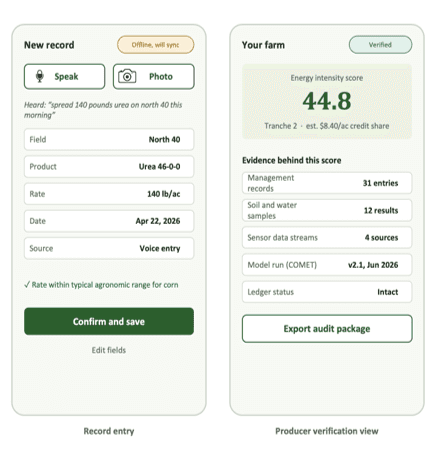
Designed for bidirectional verification: producers and auditors can verify farm scores, while farmers can verify payments and custody-linked claims.
YearS
Overview

Challenge
Agricultural verification and traceability require records that can be connected back to their originating agents, activities, measurements, management records, and model runs. Without complete lineage, validated inputs, custody controls, and clear permissions, producers, auditors, and farmers cannot confidently verify scores, deliveries, or payments.
Claim or decision
The system will use provenance, chain-of-custody, validation, and security controls together so that an asserted value can be traced to its source records, checked for integrity, and shared only with the farmer's consent.
Stakeholders
Farmers; ethanol producers; auditors; receiving parties; laboratory and instrument operators; model developers; and technical partners responsible for post-award delivery.
Evidence used
Farmer management records; harvest records; field, date, yield, and weight data; soil samples; soil-water samples; soil-moisture measurements from LI-COR LI-8150-205 probes; N2O and NH3 flux data from LI-COR LI-8100-104 chambers; instrument ranges and units; fertilizer and tillage entries; equipment displays; scale tickets; product labels; model inputs and runs; delivery confirmations; consent grants; and user-evaluation measures.
Method
Each record is stored with its originating agent, creating activity, creation time, and identifiers for its input records. Finalized records receive a SHA-256 hash and are appended to a blockchained ledger, while submitting parties digitally sign entries. Harvest and delivery records are matched by farm, crop, date, and weight and checked through automated mass-balance rules. Instrument and laboratory values are validated against type, units, and physical measurement ranges. Farmer reports enter through typed, voice, or photo inputs, with speech-to-text, field extraction, and OCR supporting structured submission checks. Access is controlled through least privilege, with TLS 1.3, AES-256, and stored consent grants protecting data.
Process
What We Developed: a provenance-based digital verification and traceability system with lineage graphs, chain-of-custody accounting, instrument and laboratory data integration, farmer reporting through mobile inputs, automated validation, role-based access, encryption, consent grants, and delivery documentation including a data dictionary and API specifications.
Results
The proposed system is intended to support the post-award pathway described in the project outcomes. Its performance will be evaluated through active use, data completeness, time per record, user satisfaction, and refinement based on farmer feedback during the first year.